



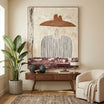
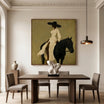
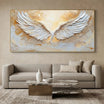
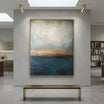





Your minimalist living room has a comfortable sofa, carefully chosen furniture, and plenty of natural light. Yet something still feels missing. The space looks attractive in photographs but seems impersonal when you're sitting in it.
Before adding cushions, replacing furniture, or repainting the walls, look at how the room works. Sometimes the problem isn't a lack of decoration. It could be harsh lighting, furniture that feels disconnected, or a wall with no clear purpose.
Wall art can help, but only when it addresses the right problem.
Why Does Your Minimalist Room Still Feel Cold?
Consider two simple living rooms.
The first has a cream sofa, oak coffee table, linen curtains, and warm white walls. Even without much decoration, its materials and lighting create variation.
The second has a white leather sofa, glass table, polished floor, and bright overhead lights. Its furniture is just as carefully selected, but almost every surface looks smooth and reflective.
Adding a painting might improve the second room. However, if harsh overhead lighting is responsible for much of the discomfort, artwork alone won't correct it.
Start with a practical assessment.
| What you notice | Possible cause | What to try first |
|---|---|---|
| The room looks harsh at night | Exposed bulbs or overly bright overhead lighting | Test softer, layered lighting |
| Furniture looks disconnected | Pieces are spaced or arranged without a clear relationship | Reconsider furniture positions |
| The sofa wall feels unfinished | The main seating area lacks a visual anchor | Test one suitable artwork |
| Everything looks smooth and uniform | Little variation between visible surfaces | Compare a dimensional artwork with other material changes |
| The room feels busy despite having few objects | Several small focal points compete | Remove or rearrange items |
Make one adjustment before introducing another.
This gives you a better chance of identifying what actually improves the room instead of accumulating decorations that conceal the original problem.
What If Your Minimalist Living Room Has No Clear Focal Point?
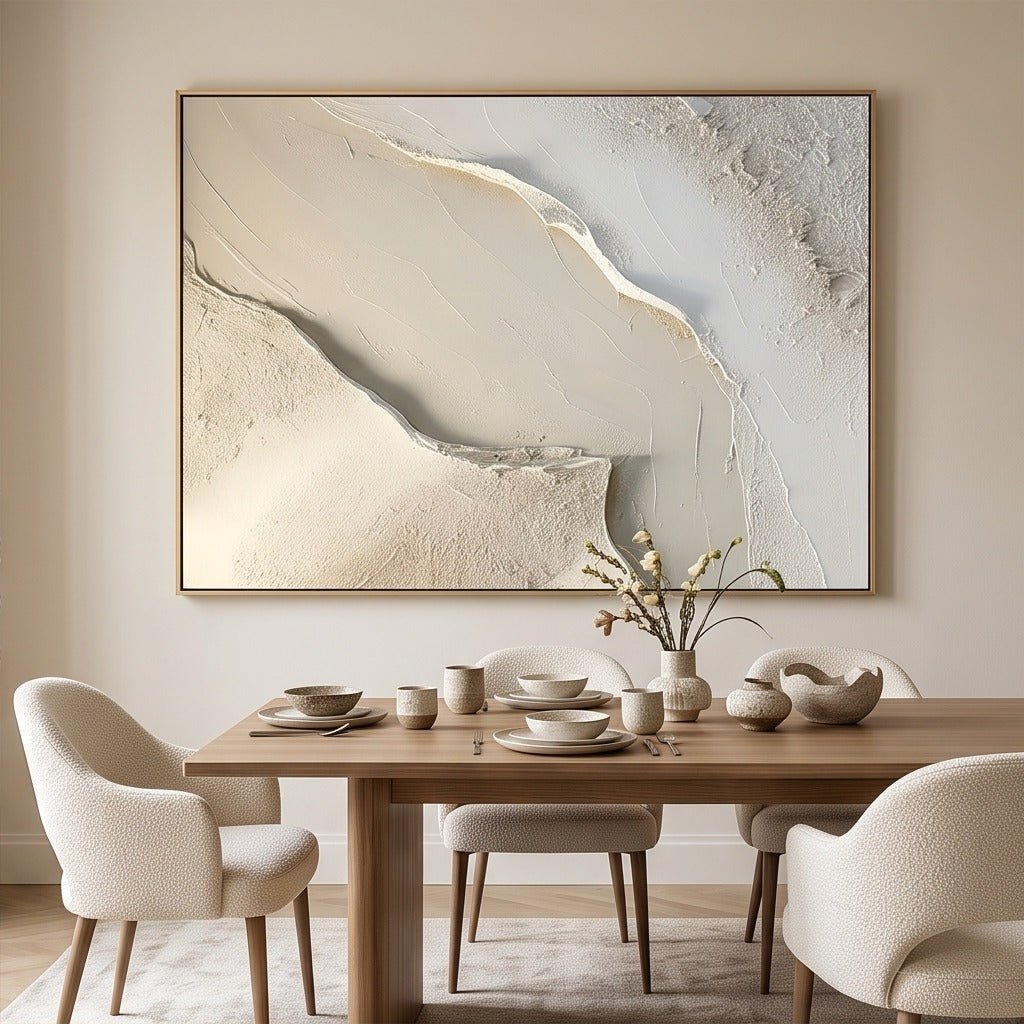
Imagine an ivory sofa facing a glass coffee table. A slim floor lamp stands beside the sofa, and the wall above it is empty.
From the doorway, your attention moves between the lamp, a television, and several small objects on the table. Nothing visually connects the seating arrangement.
You might assume that the blank wall needs decorating. Before buying a painting, however, look at the furniture placement.
If the sofa sits awkwardly between a doorway and a window, moving it—or adjusting the rug and coffee table—may establish a stronger arrangement without adding anything to the wall.
If the furniture already feels connected, but the area above the sofa still appears unresolved, artwork becomes a more useful intervention.
A painting with a composition that remains recognizable from across the room can provide a visual destination. You won't necessarily need several small prints or a shelf full of accessories.
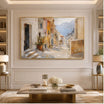
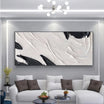
Textured Neutral Abstract Wall Art is one artwork direction worth comparing for this situation. Rather than choosing it solely because of its neutral palette, assess whether its forms and surface variation have enough presence beside your furniture.
To test the idea, temporarily place a paper template or other lightweight visual mock-up on the wall. Step back to the doorway and observe whether the seating arrangement feels more complete.
If nothing improves, reconsider the furniture and lighting before purchasing.
For general artwork proportions and placement, the existing minimalist wall art guide provides a more detailed reference.
What If the Room Feels Too Rigid?
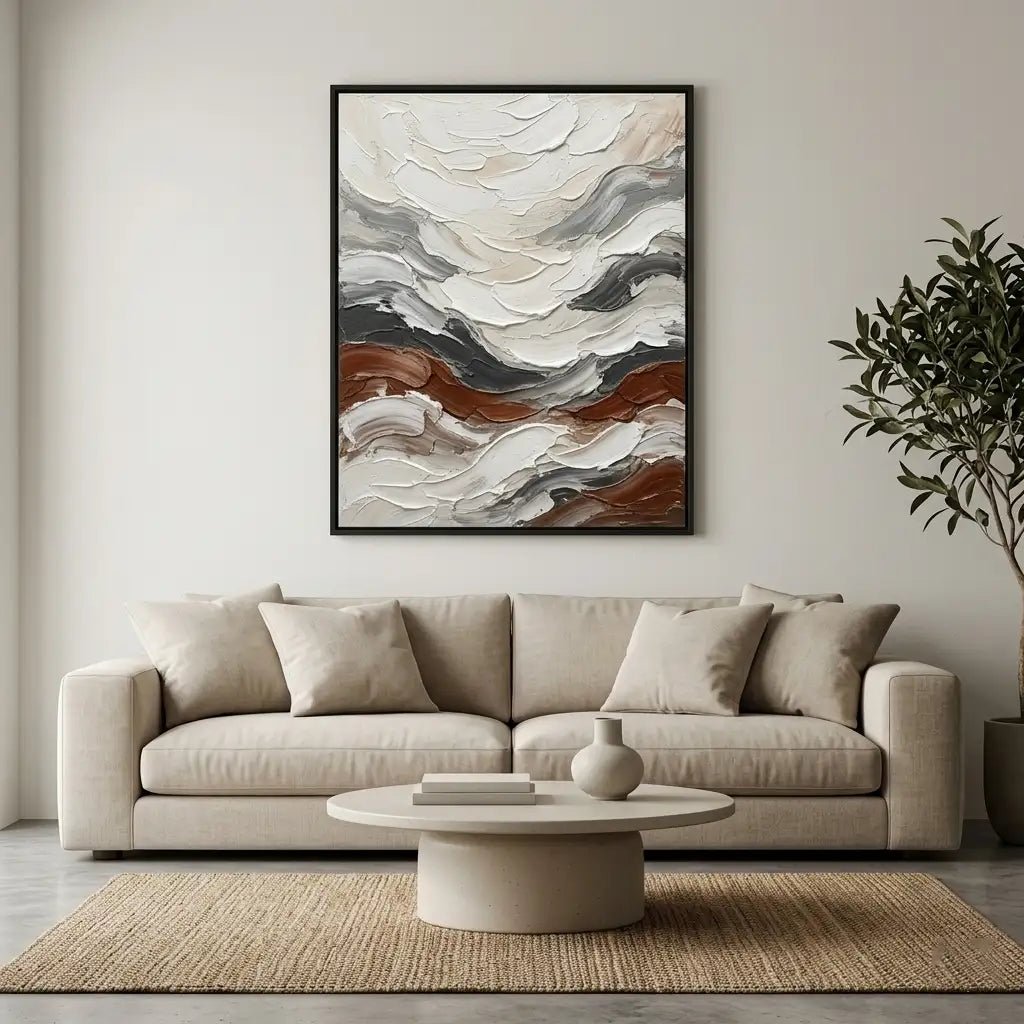
A different problem appears in a room dominated by rectangular objects.
Picture a charcoal sofa with square arms, a rectangular coffee table, black metal shelving, and linear ceiling lights.
The arrangement is orderly, but the repetition of straight lines makes the space feel formal.
First, examine the furniture and accessories.
A curved table lamp, softer upholstery, or a different furniture arrangement might already provide the variation you need.
If those changes aren't practical and the wall is suitable for artwork, consider a composition with forms that behave differently from the surrounding furniture.
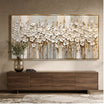
Neutral Textured Abstract Wall Art #TA050, with its flowing forms and layered surface, offers a different visual rhythm from a strictly geometric arrangement.
However, don't assume that every curved or irregular painting will soften a room. An extremely busy composition can introduce another kind of visual tension.
Compare the amount of open space within the painting with the details already present around the wall.
The useful test: Does the artwork interrupt the repetition of rigid shapes while allowing the furniture to remain visually organized?
If the answer is yes, it may offer a worthwhile improvement. If the room starts to feel crowded, a quieter composition—or no additional artwork—may be better.
What If the Colors Are Right but the Room Still Looks Flat?
Suppose you're satisfied with the room's palette. You don't want stronger colors or additional furniture.
Nevertheless, the interior looks unusually uniform.
Before choosing textured artwork, determine whether the real problem is lighting.
In a room with only diffuse ceiling light, even natural wood, woven fabrics, and raised paintings may appear less dimensional. Introducing a separate lamp or changing the direction of an existing light source can reveal details that were already present.
If lighting is adequate but the wall still lacks surface variation, a physically textured canvas may be worth considering.
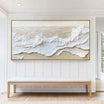
Neutral Textured Abstract Wall Art #TO810 offers a useful example of dimensional artwork. Its raised circular forms, palette-knife ridges, and irregular textured bands introduce a more sculptural surface than a conventional flat canvas.
In a room dominated by smooth furniture and uniformly painted walls, these details may provide contrast without requiring a completely new color scheme.
But texture has limitations.
A richly textured painting won't repair an awkward seating arrangement, and subtle raised details may contribute little if the artwork is placed where they are barely visible.
Evaluate the canvas from two distances: where you usually sit and where you approach the wall.
From the seating position, its overall composition should still make sense. Closer up, its physical details should provide additional interest.
If the artwork only looks effective in a close-up product photograph, it may not be the right solution for your room.
What Should You Change in a Minimalist Bedroom That Feels Unfinished?
Consider a bedroom with a low upholstered bed, two small bedside tables, and soft off-white walls.
The room has comfortable lighting and very little decoration, yet the bed appears isolated.
Begin by checking the relationship between the bed and nearby furniture.
Are the bedside tables disproportionately small? Do the lamps appear disconnected from the headboard? Does the room have an unusually large amount of empty wall above the bed?
Sometimes adjusting the furniture arrangement is enough.
If the furniture is well balanced but the wall still needs a connecting element, a single painting may complete the composition.
The best choice depends on what is already visible.
A plain upholstered headboard can accommodate artwork with a more recognizable form. A sculptural or patterned headboard may benefit from a quieter composition.
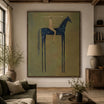
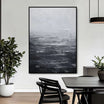
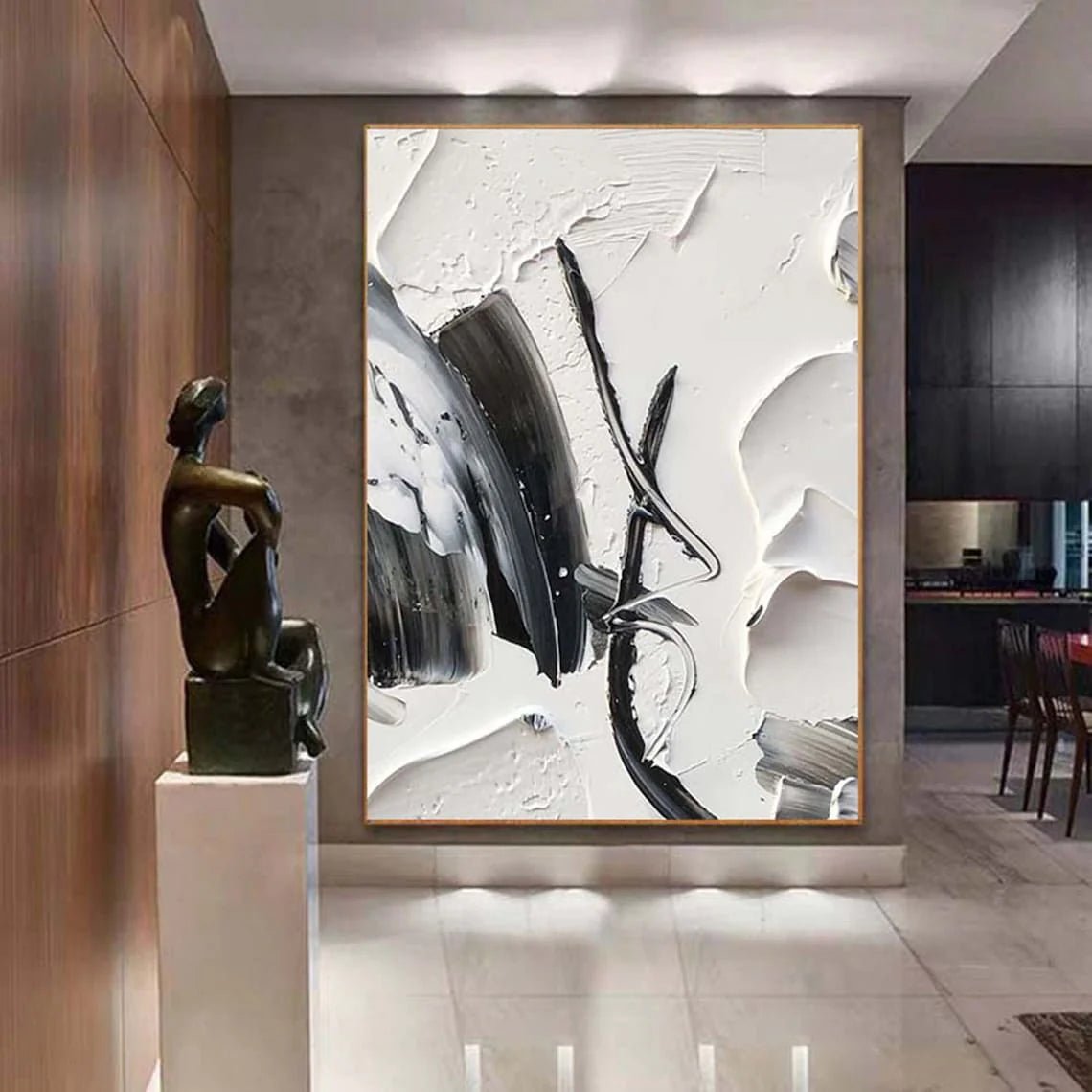
Likewise, a bedroom with black lamp bases and dark window frames might accommodate restrained monochrome artwork such as Black and White Abstract Wall Art #TO021.
A room dominated by softer furnishings might call for less contrast.
There is no requirement that a minimalist bedroom use exclusively beige artwork.
View the arrangement from the doorway and from the foot of the bed. If the artwork gives the sleeping area a clearer identity without competing with the lighting or headboard, it has a useful purpose.
If it makes an already balanced wall feel busy, leave the space undecorated.
When Should You Avoid Adding More Wall Art?
Not every uncomfortable minimalist room needs another painting.
There are three situations in which you should consider other changes first.
The room feels uncomfortable mainly after sunset.
Look at the lighting. Harsh overhead illumination or an absence of softer secondary light sources may contribute more to the atmosphere than the artwork does.
The furniture doesn't relate to the room.
A sofa placed too far from its coffee table or seating arranged around several unrelated focal points may make the room feel disconnected. Reconsider the layout before trying to fix it with wall decoration.
The wall already contains competing elements.
Several small prints, a mirror, shelves, and decorative objects can create a fragmented arrangement. Removing or simplifying those elements may improve the room more than introducing another piece.
One way to test this is to take a photograph of the wall, then temporarily remove a few smaller decorations.
Compare the before-and-after arrangement.
Does the wall become more coherent? If so, you may need fewer objects rather than more.
Only introduce artwork when you can explain what it is supposed to accomplish.
Make the Smallest Change That Solves the Problem
A minimalist room can feel cold for several reasons, and wall art is only one possible solution.
If lighting is the issue, improve the lighting first. If furniture feels disconnected, work on the layout. If the room needs a visual anchor or a different surface quality, artwork may be the most useful addition.
Choose a painting for a clearly identified purpose rather than assuming that every empty wall needs filling.
At Tactile Atelier, you can compare hand-painted compositions with different forms and surface characteristics against the needs of your actual room.
Sometimes one suitable canvas makes the difference. Sometimes the best decision is to change something else—and leave the wall alone.


Leave a comment
This site is protected by hCaptcha and the hCaptcha Privacy Policy and Terms of Service apply.