
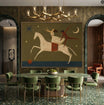
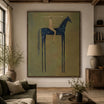

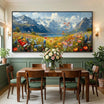

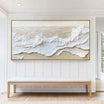
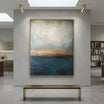
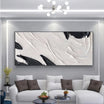
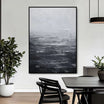
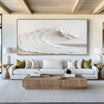



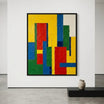
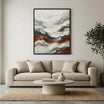
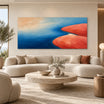

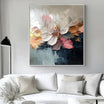
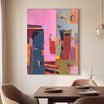


The difference between an oil and acrylic landscape painting is not simply that one is traditional and the other is modern. Both media can produce soft skies, sharp mountain forms, transparent layers and pronounced texture. The result depends on the artist’s technique, the paint formulation, the support and the final surface.

For a buyer, the more useful comparison is how the finished painting looks in the room, how its surface behaves and what care it may require. The medium matters, but it should not replace a close assessment of the individual artwork.
Oil vs Acrylic Landscape Painting at a Glance
|
Factor |
Oil Landscape Painting |
Acrylic Landscape Painting |
|
Working behavior |
Usually allows longer blending and adjustment |
Usually dries faster and supports quicker layering |
|
Possible appearance |
Smooth transitions, glazing or heavy impasto |
Flat color, crisp edges, washes or heavy texture |
|
Surface character |
Can range from matte to glossy |
Can range from matte to glossy |
|
Paint film |
Properties vary with the paint layers and support |
Generally more flexible but may retain surface dust |
|
Care |
Avoid heat, moisture, direct sunlight and unsuitable cleaning |
Avoid heat, moisture, direct sunlight and unsuitable cleaning |
|
Best choice |
The painting whose composition and surface suit the room |
The painting whose composition and surface suit the room |
These are common tendencies rather than guarantees. It is not always possible to identify the medium accurately from a photograph.
How Oil Landscape Paintings Are Made
Oil paint consists of pigment suspended in a drying oil, traditionally linseed oil. It generally remains workable longer than water-based acrylic, giving the artist more time to blend transitions, adjust edges and develop gradual changes in atmosphere.
These qualities are useful for skies, mist, water and distant landforms, but they do not mean that every oil landscape will look soft or realistic. Artists can also use oil paint for broken marks, palette-knife ridges and thick impasto. A thinly painted oil work, by contrast, may have little visible texture.
Oil paint hardens through chemical interaction with oxygen rather than simply losing water. Thick passages and different pigments may dry at different rates, so a painting can continue curing after its surface feels dry.
The finished appearance depends on more than the binder. Pigments, mediums, brushwork, layer thickness, support and varnish can all affect gloss, saturation and texture.
How Acrylic Landscape Paintings Are Made
Acrylic paint uses pigment held in an acrylic polymer binder. Water-based artists’ acrylic normally dries faster than oil, allowing one layer to be placed over another with less waiting time.
This can support crisp edges, separated areas of color and rapid revisions. It can also be diluted for transparent effects or combined with gels and pastes to create raised surfaces.
Some acrylic landscapes resemble watercolor, while others resemble heavily worked oil paintings. The visible result depends on technique and additives as much as the medium itself.
Dry acrylic is no longer water-soluble in the same way as wet paint. However, this does not mean the finished surface should be washed. Water, cleaning products and friction may still affect surface additives, accumulated dirt or the appearance of the paint film.

Which Medium Has Better Color?
Neither medium is automatically more colorful, accurate or resistant to fading.
Color depends on pigment quality, pigment concentration, binder, surface, varnish and display conditions. An oil painting may contain deep transparent passages, while an acrylic painting may use clean, saturated color. Either medium can also produce a muted, atmospheric landscape.
Rather than judging color by the medium label, examine the painting itself:
- Do the dark areas retain visible variation?
- Are the highlights controlled rather than chalky?
- Do the transitions between foreground and distance feel convincing?
- Does the palette suit the room’s natural and artificial light?
- Are close-up images available to show color and surface variation?
A landscape viewed on a bright screen may appear more luminous than it will on a shaded wall. Product photographs are useful, but they should be considered alongside the room’s lighting and wall color.
Which Medium Creates More Texture?
Both oil and acrylic can create pronounced texture.

Oil paint can retain brush and palette-knife marks, particularly when applied thickly. Acrylic can also be built into raised surfaces with gels, pastes or thicker applications.
A photograph may show that a painting is textured without revealing the exact materials used to create that texture. If the medium is important to the purchase, rely on the product description or confirmation from the seller rather than appearance alone.
Evaluate what the texture does within the composition:
- Does it define rocks, trees, waves or terrain?
- Does it create movement across an abstract landscape?
- Is it visible from the expected viewing distance?
- Will side lighting make it stronger than intended?
- Can the raised surface be protected from repeated contact?
Subtle texture may suit a bedroom or quiet sitting area. Strong impasto can be effective on a larger wall where the surface is viewed from several directions.
Composition Usually Matters More Than Medium
An oil landscape with unsuitable dimensions or orientation will not work in a room simply because oil is perceived as traditional. An acrylic landscape with the right composition may be the better choice even if the buyer originally preferred oil.
Evaluate the structure of the image before comparing materials:
- Horizontal landscapes often relate well to sofas, consoles and beds.
- Vertical landscapes can suit narrow walls or emphasize ceiling height.
- Open horizons may make a composition feel calm and expansive.
- Dense forests or mountain forms usually carry more visual weight.
- Strong contrast creates a more assertive focal point than a close tonal range.
For a broader framework covering subject, scale, color and placement, read the guide to choosing a landscape painting.
Can You Tell Oil From Acrylic by Looking?
Sometimes, but not reliably.

Slowly blended transitions, glossy passages or rounded impasto may suggest oil. Crisp layers, flatter color or sharply defined edges may suggest acrylic. Artists can manipulate both media to produce similar results, while varnish can further change gloss and saturation.
Product photography also reduces useful clues. Lighting, image processing and screen settings may make a matte surface appear glossy or flatten visible texture.
Do not identify the medium from brushwork or shine alone. Check the product specifications, ask the seller or review any available material information.
Which Is Easier to Care For?
Neither medium should be treated as maintenance-free.
Oil and acrylic paintings have different physical properties, but preventive care is appropriate for both. Acrylic surfaces can retain dust and may be affected by inappropriate cleaning methods, so routine care should focus on reducing exposure rather than attempting to wash the painted surface.
For either medium:
- Keep the painting away from persistent moisture and major temperature changes.
- Avoid prolonged direct sunlight.
- Do not use household cleaners, water or solvents on the painted surface.
- Avoid pressing or wrapping materials directly against raised paint.
- Do not place the artwork where it will be touched repeatedly.
- Consult a qualified conservator if cracking, flaking, staining or impact damage appears.
Do not assume that a varnished painting is washable. Surface coatings vary, and a cleaning method suitable for one work may damage another.
How to Choose for a Specific Room
Consider the Light
Side lighting emphasizes texture. It can make palette-knife ridges and raised marks more visible, while flat frontal light may reduce the effect.
Glossy passages can produce glare when placed opposite a strong window or spotlight. Review the proposed location throughout the day rather than judging it under one lighting condition.
Consider the Viewing Distance
Large forms and clear tonal changes remain readable across a room. Fine brushwork is easier to appreciate in a hallway, reading corner or other position where viewers can stand closer.
A highly detailed landscape may lose part of its effect when placed high above furniture or viewed only from the opposite side of a large room.
Consider the Existing Materials
A softly blended landscape can balance hard architectural lines, glass and metal. A more graphic painting may give structure to a room dominated by upholstery and rounded forms.
Wood, stone, linen, leather and painted furniture also affect how warm, cool, formal or relaxed the artwork appears.
Consider Visual Weight
Dark forests, dense marks and strong mountain silhouettes usually carry more visual weight than pale skies, mist or open water.
Compare this visual weight with the furniture below the artwork and with other focal points in the room. A dark landscape may need more open wall around it than a lighter painting of the same dimensions.
Oil or Acrylic: Which Should You Choose?
Choose an oil landscape if you are drawn to the appearance of a particular oil painting—its transitions, surface, marks and composition—not because oil is automatically superior.
Choose an acrylic landscape if the individual artwork provides the color, structure and texture the room needs—not because acrylic is automatically easier to own.
When two paintings are equally suitable, confirmed materials and care requirements can help with the final decision. In most cases, however, composition, dimensions, visual weight and workmanship will have a greater effect on how the artwork looks in the home.
Final Decision Checklist
Before choosing an oil or acrylic landscape painting, confirm:
- The composition suits the shape of the wall.
- The dimensions have been tested against nearby furniture.
- The palette works in both daytime and evening light.
- The texture remains appropriate at the expected viewing distance.
- The medium is clearly stated rather than assumed from a photograph.
- The artwork will not receive prolonged direct sunlight.
- You understand the seller’s framing, shipping and care information.
The better medium is the one used successfully in a painting that fits your room. When comparing hand-painted artwork from Tactile Atelier, begin with composition, scale and surface character before treating “oil” or “acrylic” as the deciding factor.
FAQs
Is Oil Painting Better Than Acrylic Painting?
Not universally. Oil usually offers longer working time, while acrylic normally dries faster. Either medium can produce detailed, atmospheric or textured landscapes. The finished composition, materials and workmanship are more important than a simple ranking of the two.
Do Oil Paintings Last Longer Than Acrylic Paintings?
A painting’s lifespan cannot be predicted from the medium name alone. Pigments, layer construction, support, environmental conditions, handling and previous treatment all matter. Acrylic is also a newer medium, so its very long-term aging history is less extensive than that of oil.
Does Acrylic Paint Look Cheaper Than Oil Paint?
No. A poorly made painting can look weak in either medium, while a well-executed acrylic painting can have complex color, controlled edges and substantial texture. Judge the individual artwork rather than using the medium as a shortcut for quality.
Can I Clean an Acrylic or Oil Painting With Water?
Do not apply water or household cleaners without material-specific professional advice. Water may disturb dirt, coatings or components in the paint film, while rubbing can alter gloss or damage raised areas. Preventive care is safer than wet cleaning.
Can Oil and Acrylic Paintings Be Displayed in the Same Room?
Yes. They do not need to share the same medium. A consistent relationship in scale, palette, framing or subject is usually more important than whether both works were made with identical paint.


Leave a comment
This site is protected by hCaptcha and the hCaptcha Privacy Policy and Terms of Service apply.