





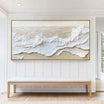



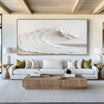



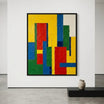


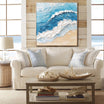


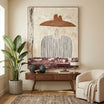

Diptych wall art consists of two coordinated panels displayed as one complete artwork. The two canvases may divide a continuous image or contain separate compositions connected by color, texture, or subject.
Choosing the right diptych requires one important adjustment: measure the complete arrangement, not just one panel. The final size includes both canvases and the gap between them. That combined width determines whether the artwork will fit the wall, relate to the furniture, and maintain enough surrounding space.
This guide explains how to calculate diptych dimensions, choose the center gap, align the panels, and install them accurately.
What Is Diptych Wall Art?
A diptych is an artwork composed of two panels designed to be viewed together.

The panels may be:
- Two equal canvases
- Two panels with different dimensions
- Two halves of one continuous image
- Separate but coordinated compositions
- Mirrored or contrasting designs
Unlike two unrelated paintings, a diptych depends on the relationship between its panels. Their order, spacing, alignment, and combined dimensions all affect the finished composition.
The wall art set of 2 collection includes paired artworks designed to be displayed together rather than selected as separate decorative pieces.
Continuous Image or Coordinated Pair?
Before calculating the spacing, determine how the two panels interact.

Continuous-Image Diptych
A continuous-image diptych divides one composition across two canvases. A landscape, abstract form, horizon line, or area of color moves through the center gap.
This format requires precise alignment. Lines and shapes should appear to continue naturally from one panel to the other. The gap should remain narrow enough to preserve the image while still showing that the work consists of two pieces.
Coordinated Two-Panel Set
A coordinated set contains two separate compositions connected through subject, palette, texture, or visual rhythm.
The Neutral Abstract Canvas Set, for example, uses related linear and geometric forms across two canvases. Each panel has its own structure, but the repeated colors and shapes allow the pair to function as one arrangement.
Coordinated sets allow slightly more flexibility in spacing because the image does not need to connect precisely across the gap.
How to Calculate the Total Width of a Diptych
Product dimensions often describe each panel individually. To determine how much wall space the artwork will occupy, add both panel widths and the center gap.

For two equal panels:
Total width = panel width × 2 + center gap
If each panel is 24 inches wide and the planned gap is 3 inches:
24 × 2 + 3 = 51 inches
The complete arrangement will occupy 51 inches of wall width.
For panels with different widths:
Total width = left panel width + right panel width + center gap
For example:
20 + 30 + 3 = 53 inches
| Width of each panel | Center gap | Complete width |
| 16 inches | 2 inches | 34 inches |
| 24 inches | 3 inches | 51 inches |
| 32 inches | 4 inches | 68 inches |
Use the finished outer dimensions when calculating the total width. If the panels will be framed, include the frames rather than measuring only the canvas surface.
How Wide Should Diptych Wall Art Be Above Furniture?
When a diptych hangs above a sofa, bed, console, or sideboard, compare the complete installed width with the furniture below it.
A total width equal to approximately two-thirds to three-quarters of the furniture width is a practical starting point.
For an 84-inch sofa, for example, begin by testing a complete arrangement approximately 56 to 63 inches wide. This total must include both panels and the center gap.
The ratio is not a fixed rule. Frame thickness, wall boundaries, nearby lighting, and the visual strength of the artwork may require more or less space.
For installations above a headboard, the large wall art for bedrooms guide provides more specific advice on bed width, available wall height, and bedroom sightlines.
How Much Space Should Be Between Diptych Panels?
For many residential installations, a gap of approximately 2 to 4 inches works well.

Choose a narrower gap when:
- The panels are relatively small
- One image continues across both canvases
- Lines or shapes must align across the center
- The artwork is viewed from close range
Choose a wider gap when:
- The panels are large
- Each canvas contains a separate composition
- The artwork is viewed from farther away
- More visible wall space improves the rhythm of the pair
The gap should be proportional to the panel size. A four-inch opening may look excessive between two narrow canvases but balanced between two large panels.
The wall color also affects how noticeable the division appears. Strong contrast between the wall and the panel edges emphasizes the gap, while similar tones make it less prominent.
How to Align Diptych Panels
Most diptych wall art should share the same top, bottom, and center lines.
For a continuous composition, check whether the following elements align:
- Horizon lines
- Geometric forms
- Branches or botanical shapes
- Areas of color
- Directional brushwork
- Subjects extending across both panels
Even when the canvases have identical listed dimensions, their hanging hardware may sit at slightly different positions. Measure the hardware on each panel instead of assuming both mounting points are the same.
A coordinated pair does not need continuous lines, but its outer edges and visual centers should still appear intentionally aligned.
How to Hang Diptych Wall Art
1. Confirm the Panel Order
Place both panels on the floor in their intended order. Check the product images or composition to confirm which panel belongs on the left and which belongs on the right.
2. Calculate the Complete Width
Add the two finished panel widths and the chosen center gap. This gives you the full installation width.
3. Mark the Center of the Arrangement
Above furniture, use the center of the sofa, bed, console, or sideboard as the main reference point. On an open wall, use the center of the uninterrupted installation area.
For two equal panels, the center of the gap should align with this mark.
If the panels have different widths, center the complete arrangement rather than centering the gap.
4. Test the Layout With Paper Templates
Cut two paper templates using the finished dimensions of the panels. Attach them to the wall with removable tape and leave the intended gap between them.
Check the arrangement from the doorway and normal viewing position. Confirm that the pair has enough open wall on both sides.
5. Set the Hanging Height
On an open wall, positioning the visual center of the full arrangement approximately 57 to 60 inches from the floor provides a useful starting point.
Above furniture, a distance of approximately 6 to 10 inches between the furniture and the bottom of the panels often creates a visual connection.
Adjust the position for furniture height, ceiling height, lighting, and the actual viewing angle.
6. Measure Both Hanging Points
Measure the distance from the top and side of each panel to its hanging hardware. Transfer these measurements to the wall.
Do this separately for both panels, even if they are the same size.
7. Hang and Level the First Panel
Install one panel and confirm that it is level. Do not position the second panel by visual estimation alone.
8. Install the Second Panel
Use the planned center gap and alignment line to position the second panel. Confirm that its top and bottom edges match the first.
9. Check the Finished Spacing
Measure the gap at both the top and bottom. These measurements should be equal. Finally, view the complete artwork from the room’s main entrance or seating position.
Diptych vs One Large Canvas
A diptych introduces a central pause into the composition. This division can make a wide arrangement feel lighter and add visual rhythm to the wall.
One large canvas offers an uninterrupted image and may be more suitable when the subject has a dominant central focal point that should not be divided.
Choose a diptych when:
- The composition naturally divides into two parts
- The room benefits from symmetry
- You want visible wall space inside the artwork
- Two panels are easier to move and install
- The furniture or architecture has a strong center line
Choose one canvas when uninterrupted movement or a single central subject is more important.
The Neutral Abstract Diptych Wall Art demonstrates how two coordinated panels can establish balance while allowing the wall to remain visible between them.
Diptych vs Triptych Wall Art
A diptych contains two panels and one center gap. A triptych contains three panels and two gaps.
A diptych usually requires less wall width and creates stronger symmetry around one central division. A triptych produces a longer rhythm and may suit compositions that develop across three distinct sections.
Do not choose the number of panels only according to the amount of empty wall. The artwork should be designed for that format. Splitting a two-part composition into three pieces—or removing one panel from a triptych—can disrupt its balance.
Common Diptych Hanging Mistakes
Measuring Only One Panel
The listed size may describe each canvas rather than the complete set. Always add both panel widths and the center gap.
Leaving Too Much Space Between the Panels
Excessive spacing can make a connected composition look like two unrelated artworks.
Using Unequal Spacing
Measure the center gap at the top and bottom after installation. Small inconsistencies are noticeable because the two-panel layout depends on symmetry.
Centering the Gap When the Panels Are Different Sizes
The gap represents the center only when the panels have equal widths. For unequal panels, calculate and center the complete arrangement.
Assuming the Hanging Hardware Matches
Measure each panel separately. Identical canvas dimensions do not guarantee identical hardware positions.
Reversing the Panel Order
Confirm the intended left-to-right sequence before installing, particularly when the image continues across both canvases.
Frequently Asked Questions
What is the ideal spacing between diptych panels?
Approximately 2 to 4 inches is a useful starting range. Use a narrower gap for small panels or a continuous image and a slightly wider gap for large, coordinated compositions.
How do I calculate the total size of diptych wall art?
Add the width of both panels and the center gap. For two equal panels, use: panel width × 2 + gap width. Include any frames in the final measurements.
Final Takeaway
Diptych wall art should be measured and installed as one complete composition. Calculate the width of both panels plus the center gap, center the full arrangement over the correct visual anchor, and measure each hanging point separately.
When panel dimensions, spacing, order, and alignment are planned together, two canvases can create one balanced and intentional focal point.


Leave a comment
This site is protected by hCaptcha and the hCaptcha Privacy Policy and Terms of Service apply.