
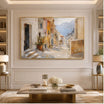


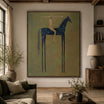
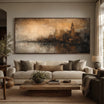
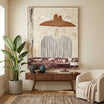
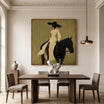
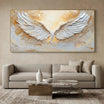

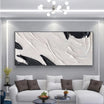







A hallway gallery wall should follow the usable wall and the way people move past it. On a long clear stretch, a simple sequence may work; between doorways, smaller independent groups often make more sense. At the end of a narrow passage, one strong painting can be enough. When planning your hallway gallery wall, check door movement, close viewing and lighting before choosing the number of artworks. The arrangement needs to remain readable from either direction without making the passage feel crowded.
What Makes a Hallway Gallery Wall Different From One in a Living Room?
In a living room, you may see a group from a sofa several steps away. In a hallway, you often approach from one end, pass close to the frames and leave through a side door. A composition that looks convincing in a straight-on photograph may be difficult to read at that oblique angle. Start by walking the route instead of standing against the opposite wall.
Architecture also interrupts the picture. Door trim, switches, sconces and handrails divide the available surface into separate zones. A strong view toward the far end can make an end-wall painting more prominent than several works along the side. Dim lighting may leave relief or subtle color differences less apparent than they look in a product photograph.
A gallery is a poor choice where there is no useful uninterrupted wall or where people regularly brush against the proposed frames. Do not force pictures around every switch or crowd an active doorway. One suitable wall, or no artwork along the busiest stretch, may be the better decision.
If the useful space is only a single narrow bay, the guide to vertical wall art ideas for narrow walls addresses choosing one tall piece. For a hallway gallery, the additional task is making separate artworks relate across a moving route.
Which Layout Works for a Long Uninterrupted Hallway?
Corridor case A: a repeated sequence along one clear wall. Begin by identifying where the usable stretch starts and ends, excluding trim and fixtures. Mark those limits on a sketch, then reserve open space before the first painting and after the last. These end margins let the sequence stop intentionally rather than appearing squeezed between two boundaries.
Several individually purchased portrait-oriented works can establish a steady rhythm. Start with a shared centerline when their outside heights differ, or a common lower frame edge when that line reads more clearly from the entrance. Choose one reference and test it along the whole stretch. Small changes in the subjects can provide variety without requiring a complicated staggered outline.
Repetition does not require identical artwork. Similar frame finishes, related pale backgrounds or recurring upright shapes may be enough. Avoid switching between several alignment rules merely to fit one extra canvas. The interruption becomes especially noticeable when viewed down the length of the hall.
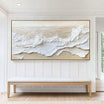
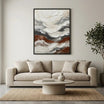
TO810's neutral textured abstract wall art is one portrait-format example with pale relief details. It could be an independently selected component of this kind of sequence. The product photograph shows the individual work, not a complete hallway installation or a ready-made series.

Move paper outlines along the sketch before committing to the number of pieces. If the last outline crowds the end margin, remove a work and redistribute the remaining space. A shorter, coherent run is easier to read than a long arrangement that loses its rhythm near the doorway.
How Can You Make a Gallery Wall Work Between Doorways?
Corridor case B: one compact group in a clear bay. Treat each uninterrupted section between doorways as its own wall. Measure from the actual trim edges and account for switches, outlets, sconces or a handrail within that area. Equal distances between paintings across the entire corridor are less useful than arrangements that fit each individual bay.
Imagine a two-piece grouping in the widest clear section, followed by one independently chosen canvas farther along the route. The pieces need not march across a doorway at a forced continuous spacing. Relate them through a quiet palette or frame finish while allowing the architecture to provide the break. This is a hypothetical arrangement of separate purchases, not a product bundle.
TO098's vertical seascape offers pale blue, navy and ochre passages to consider for one such section. Judge the complete composition against the bay's proportions and the actual lighting. Its orientation alone does not prove that a selected size will fit, and its product-room photograph is not evidence of a measured hallway gallery.

Open each door fully while testing the plan. The leaf, handle and the person using it may occupy space that looks empty when the door is shut. Keep controls and outlets usable; do not use a painting to conceal a switch you still need. Around a sconce, judge both the fixture and how its light falls on nearby art.
A smaller bay can remain blank. That pause may make the next grouping easier to notice and prevent every stretch of trim from becoming a crowded boundary. Repeat a visual connection where it helps, without asking every wall section to contain the same number of pieces.
What Should You Hang at the End of a Narrow Hallway?
Corridor case C: one painting at the visual destination. Stand at the entrance and look toward the end wall. If it is the clearest uninterrupted surface, a single vertical work may give the passage a focal point without adding several frames beside the walking route. Check the view again from the side doors: the end wall may be only partly visible from those angles.
Orientation is one part of this decision. The horizontal vs vertical wall art guide compares the two formats more generally. Here, ask which outline remains visible at the end of your actual corridor, with its trim, ceiling line and light. A portrait format is a starting point, not a requirement.
Favor a composition whose main forms remain legible from the approach. Subtle floral relief might provide quieter detail when you get closer, while a distinct light-dark boundary can help establish the outline from farther away. Test the room's normal evening lighting before assuming that either effect will be strong enough.
The neutral floral TO004 provides an example to consider for this single-work alternative. Assess its product views and selected dimensions rather than treating it as a proven installation for your end wall. If the wall includes a door or active access point, that use takes priority over creating a focal point.

How Do You Choose Artwork Scale, Color and Texture for Close Viewing?
Check a painting at both ends of the viewing range. Its large shapes should make sense as you approach, while its surface can reward a closer look as you pass. A composition that depends entirely on tiny marks may offer little at the corridor entrance. Conversely, a large saturated field may feel stronger at close range than expected.
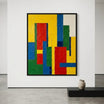
Texture can provide interest with a limited palette. TO810's pale relief is a quieter reference than the vivid teal and orange fields of TO155. Neither is automatically better for a hallway. Compare what the passage already contains: patterned flooring, colored doors or prominent lighting can reduce the need for another high-contrast element.
TO155 could suit a clear section where you want one assertive accent. If several equally vivid paintings would compete along a narrow route, choose fewer accents or a more restrained sequence. Leave open wall around the strongest work so the color has a defined place to stop.

After identifying the wall type, the Hallway Art collection provides a focused browsing starting point. Check each individual product for its composition and selected options; the collection should not be assumed to contain every artwork discussed here.
How Do You Check the Layout Before Making Holes?
Test the proposed arrangement at full scale before ordering or mounting. Use measured outside-frame dimensions, including any frame you plan to add, rather than judging the footprint from a staged room photograph.
- Mark the boundaries. Make paper outlines and attach them with tape appropriate for the wall finish. Include the full outer edges and the planned end margins.
- Use every doorway. Open doors through their normal range. Check handles, access to switches and outlets, and any interference with fixtures or handrails.
- Walk in both directions. Follow the normal route, including carrying the objects you usually move through the hall. Notice likely contact points and places where frames would feel intrusive.
- Look from both ends after dark. Use the existing lights and pause at the side entrances. Decide whether the arrangement remains visible without adding visual clutter around a sconce.
- Confirm the mounting plan. Follow maker and installer guidance for the artwork, wall construction and suitable hardware. A successful paper layout does not establish that an attachment is appropriate.
If one part still feels tight, reduce the number of paintings before changing the whole scheme. Check the original product views at TactileAtelier.com against the wall you have measured. Keep the repeated sequence for a clear long wall, independent groups for doorway bays, or a single focal work at the end. Choose the arrangement that survives the walk-through comfortably.



Leave a comment
This site is protected by hCaptcha and the hCaptcha Privacy Policy and Terms of Service apply.